

AI visual intelligence solutions for everyone
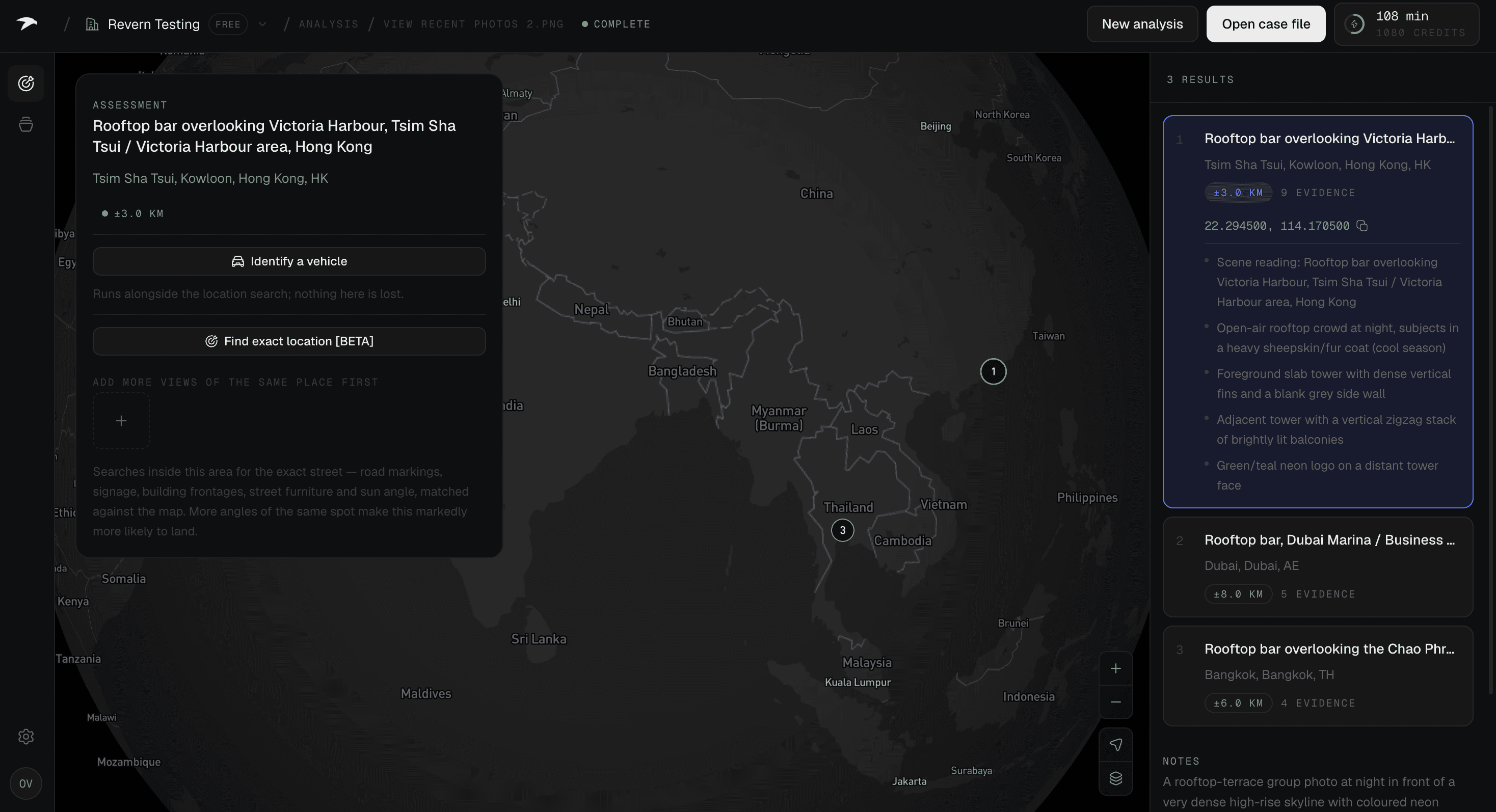
No metadata
EXIF stripped, screenshotted, re-encoded. It reads the pixels.
No landmark
A residential street with nothing famous in it is the normal case.
No legible text
Signage helps. It has never been the requirement.
Six ways to read a frame.
Five passes over one frame.
01
Metadata
Whatever the file carries, and an honest note when it carries nothing.
02
Scene
The frame decomposed into environment, structure and convention.
03
Clues
Regions worth zooming into, read at full resolution.
04
Remote
Independent sources queried to confirm or break each hypothesis.
05
Fuse
Signals weighed against the confidence policy, and a radius set.
Build on it yourself.
From $29 a month
The Personal plan includes 2,500 credits and API access, which is roughly four hours of agent time. You do not need to be an organisation.
Two endpoints
Send a photograph, get back where it was taken or what vehicle is in it, with the evidence. One request, one JSON body, no SDK to install.
Nothing is stored
No image, no coordinate, no result. That is why it is synchronous rather than a job you poll: a job has to be kept somewhere until it is collected.
What it is made of.
Evidence types
Distinct signal classes, each weighted and named in the output.
13
Independent sources
On-device, vision, geocoder, reference index, reasoning and open web.
6
Confidence tiers
Exact, nearby, area, unknown. The last one is a real answer.
4
Precision threshold
Below this a claim needs independent support or it is widened.
250m
Who it is built for.
Law enforcement
Generating leads from photographs, CCTV stills and screenshots during an investigation.
Government agencies
Public safety, national security and operational geolocation workflows.
Investigative teams
Image-based evidence analysis and independent location verification.
International security
Security operations and incident analysis across jurisdictions.
Corporate security
Investigations, risk, physical security and threat intelligence.
Insurance and fraud
Verifying where an image was captured and detecting inconsistent claims.
Journalism and verification
Establishing where visual content was captured and checking its provenance.
What it refuses to do.
Photographs are never stored.
Only the derived result is kept: the coordinate, the radius, the evidence and the notes. The image itself is never written to storage.
Faces never inform a location.
Faces and body features are excluded from location reasoning entirely, and numberplates are never read. Identification is of places and objects, not of people.
Precision has to be earned.
A claim tighter than 250 metres is only made with independent support. Everything else is widened and demoted rather than presented with a precision the frame does not carry.
Not knowing is an answer.
Where nothing in the frame pins it to a verifiable place, the result says so. A confident guess is worse than no result for everyone who has to rely on it.