

AI intelligence for Australian investigators
Revern reads an image and returns where it was taken, what is in it, and the evidence for both.
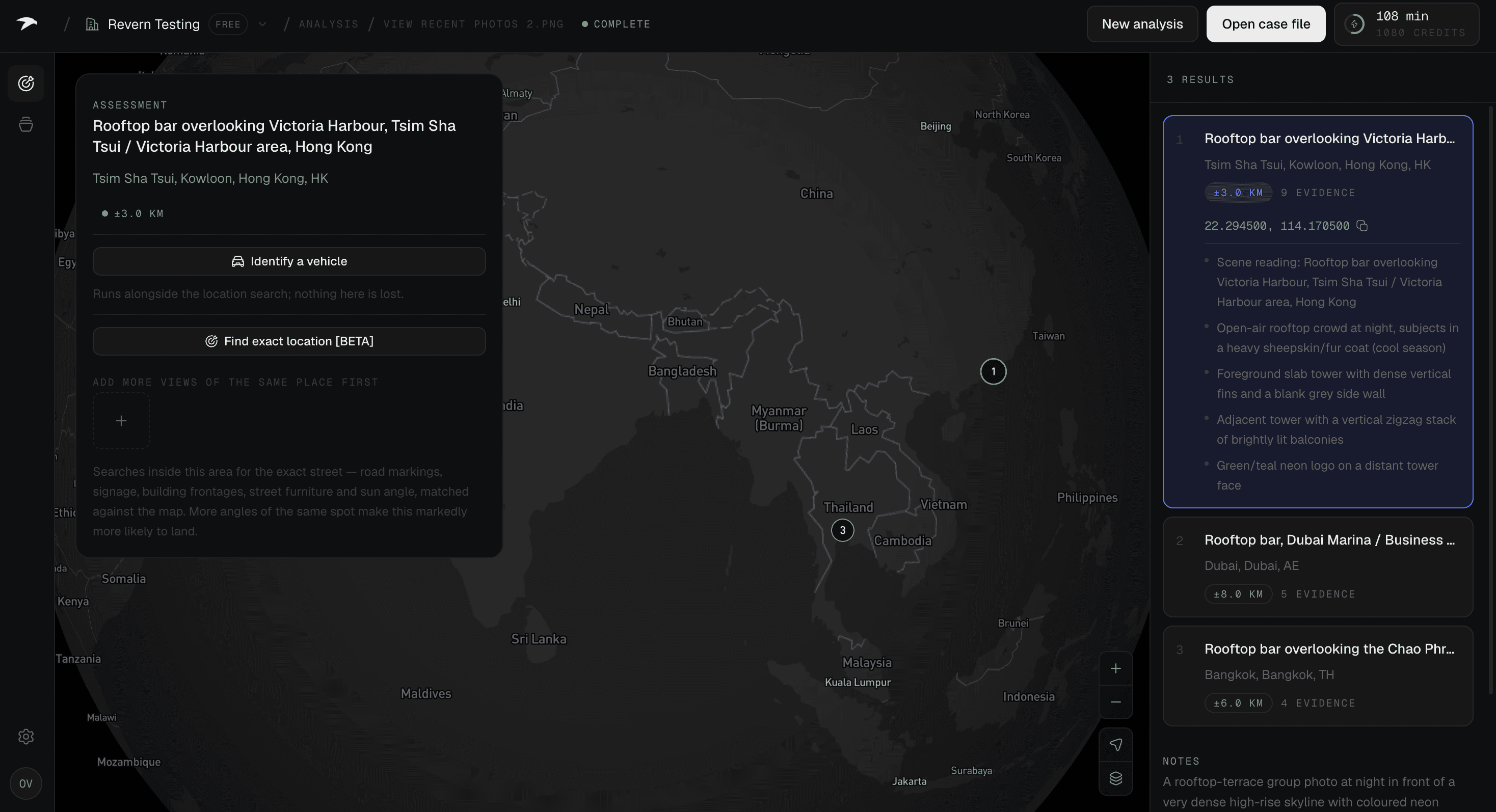
Five jobs. One input.
Skip tracing
The subject has gone quiet, but not silent. There is a marketplace listing, a photograph on a public profile, an image attached to a message months ago.
Revern reads the photograph itself and returns the region it was taken in, ranked, with a radius. Every platform strips EXIF on upload, which is exactly the case it is built for: no metadata, no landmark, no legible signage required.
A suburb to work, instead of a state.
Repossessions
A tip-off, a listing, or a photograph from the client. The security interest names a vehicle; the image may or may not be it, and may or may not be where they say it is.
Car search identifies make, model and production years from bodywork and lamp signature at angles where a plate is unreadable or absent. Geo estimation places the frame. The two run on the same image and are reported separately.
Confirm the asset and narrow the address before anybody is dispatched.
Process serving (Coming)
Three attempts at an address that turns out to be six months stale, and an affidavit that has to account for each one.
Where a frame supports it, exact location works a region down to a street and a standpoint, corroborated against street-level imagery. Where it does not, it says so and holds the wider radius rather than sending you somewhere on a guess.
Fewer attempts per service, and a reason for each one.
Field calls (Coming)
The debtor has sent a photograph as proof. The goods are at the new address, the vehicle is off the road, the premises are vacant. Somebody has to decide whether to believe it.
Clue extraction reads the frame for the specifics and reports where each one came from. Geo estimation says whether the image was captured where the account claims. Inconsistency is a finding, and it is stated as one.
Test the account before the trip, not after it.
Investigations (Coming)
A folder from the instructing solicitor. Four hundred images, no order, and a deadline that assumed somebody had already looked at them.
Evidence triage collapses duplicates, groups frames by place and capture window, and surfaces the ones that carry recoverable signal first. Results from the other solutions attach to each frame, so triage and analysis are one pass.
Start on the twelve frames that matter.
What survives the question.
A radius, never a bare pin
Every location is a coordinate and the distance it is claiming. The floor is set by tier: 60 metres at the tightest, 400 for a likely area, 8 kilometres for a region. A weak result cannot be drawn as a precise one.
Every signal named and weighted
Thirteen classes of evidence across six independent sources, each listed with what it contributed. The reasoning is on the page, so it can be agreed with, disputed, or put to a witness.
Precision has to be earned
A claim tighter than 250 metres is only made with independent support: GPS, a verified landmark, place text that resolved, or several corroborating visual matches. Everything else is widened and demoted.
A report you can attach
Each result exports as a PDF with the coordinate, the radius, the evidence and the notes, filed to a case file the whole firm can see. What went into the conclusion travels with it.
Somebody else’s photographs.
Photographs are never stored
Only the derived result is kept: the coordinate, the radius, the evidence and the notes. The image itself is never written to storage, so an instructed file does not become a retained image library.
No faces, no plates
Faces and body features are excluded from location reasoning entirely, and numberplates are never read. Identification is of places and objects. There is no facial recognition here to disclose, because there is none in it.
One case file per firm
Operators inside an organisation share case files, so a matter survives an agent being on the road or off next week. Credits stay per operator, always.
Not knowing is an answer
Where nothing in the frame pins it to a verifiable place, the result says so. For anybody whose work ends up in an affidavit, a confident guess is the worst possible output.
The whole set.
Wire it into your case management.
Locate from your own intake
Post a photograph as it arrives from a client or an instructing solicitor and file the region and radius straight onto the matter.
Identify a vehicle in the same pass
Make, model and production years from bodywork and lamp signature, returned as ranked candidates rather than one answer.
Metered from the same balance
API calls spend the credits already on the account, at the same 10 credits per minute the console charges. One bill, not two.
Nothing is retained
No image, no coordinate, no result. Material held under instruction does not become a library on somebody else’s server.